

Legal Help Hub
Counterfeit Currency Offences and Penalties in
the UK








Introduction
Counterfeit currency offences are treated seriously under UK criminal law. Making, possessing, passing, or using fake banknotes or coins can lead to prosecution, financial penalties and, in serious cases, imprisonment.
These offences can affect confidence in the financial system and may be linked to wider fraud or organised criminal activity. For that reason, allegations involving counterfeit money are often investigated carefully and dealt with firmly by the courts.
The law governing counterfeit currency offences is primarily contained in the Forgery and Counterfeiting Act 1981, which criminalises the creation, possession and circulation of fake currency.
If you are under investigation or facing charges involving counterfeit currency, understanding the law and the potential consequences is essential.
What Is Counterfeit Currency?
Counterfeit currency means imitation banknotes or coins created to look like genuine money.
This may include:
- Fake UK banknotes
- Counterfeit coins
- Altered or forged currency
- Foreign currency created to appear genuine
The key issue is usually intent to deceive. If currency is made, possessed, or used with the intention that someone will accept it as genuine, a criminal offence may arise.
Even partially completed counterfeit notes or materials intended to produce fake currency may fall within the scope of the law.
The Law on Counterfeit Money in the UK
Counterfeit currency offences are governed by the Forgery and Counterfeiting Act 1981, which replaced earlier legislation dealing with forgery and coinage offences.
The Act makes it illegal to:
- Make counterfeit currency
- Pass or tender fake notes or coins
- Possess counterfeit currency with intent to use it
- Produce or possess equipment for counterfeiting
In many cases, the prosecution must prove that the defendant knew or believed the currency was counterfeit.
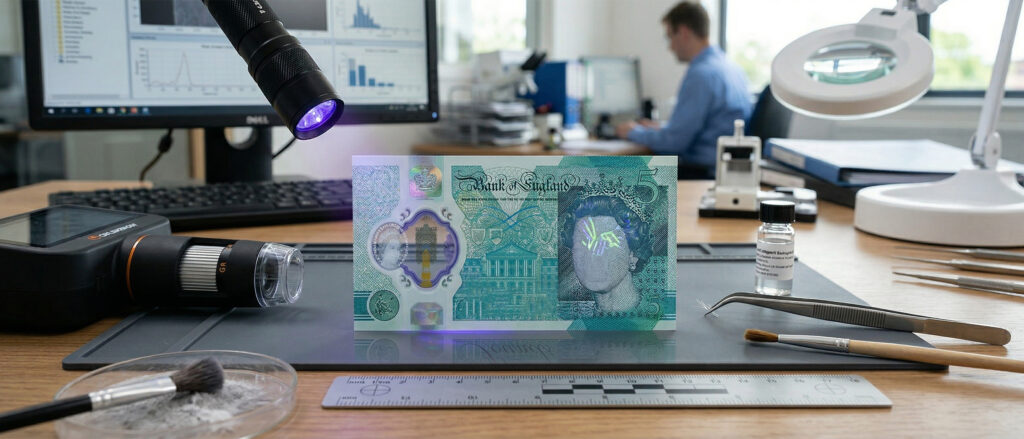
Forgery and Counterfeiting Act 1981
The legislation sets out several offences relating to counterfeit currency.
Passing counterfeit currency as genuine can be an offence where a person knowingly presents fake notes or coins as legitimate money.
Similarly, manufacturing counterfeit currency without lawful authority is a criminal offence.
Types of Counterfeit Currency Offences
Several different offences may arise depending on the circumstances.
Making Counterfeit Currency
Producing fake banknotes or coins is one of the more serious counterfeit currency offences.
This may involve:
- Printing fake notes
- Manufacturing imitation coins
- Altering genuine notes to resemble higher denominations
Because these activities can involve planning, equipment and distribution networks, they may be linked to organised criminal activity.
Passing Counterfeit Money
Passing counterfeit currency involves using fake notes or coins in transactions.
Examples include:
- Paying with counterfeit banknotes
- Attempting to exchange fake currency
- Giving counterfeit money to another person
For this offence to be proven, the prosecution must usually show that the person knew or believed the money was counterfeit.
Possessing Counterfeit Currency
It is also an offence to possess counterfeit currency with the intention that it will be used as genuine money.
Possession may include:
- Physically holding fake banknotes
- Storing counterfeit money
- Controlling access to counterfeit currency
A person may still be treated as having possession or control even if the counterfeit money is not physically on them.
Importing or Exporting Counterfeit Currency
Importing or exporting counterfeit currency without lawful authority is also prohibited.
This may involve:
- Bringing fake notes into the UK
- Sending counterfeit money abroad
- Transporting counterfeit currency across borders
These offences may be linked to wider or international criminal activity.
What Are the Penalties for Counterfeit Currency Offences?
Penalties vary depending on the specific offence and the circumstances of the case.
Serious counterfeit currency offences can carry maximum sentences of up to 10 years’ imprisonment.
However, the sentence imposed will depend on several factors, including:
- The amount of counterfeit currency involved
- The role of the defendant
- Whether the offence formed part of organised criminal activity
- The financial harm caused
Less serious offences may result in fines or shorter custodial sentences.
How Do Prosecutors Prove a Counterfeit Currency Offence?
To secure a conviction, the prosecution must prove the elements of the offence beyond reasonable doubt.
Evidence in counterfeit currency cases may include:
- Counterfeit banknotes recovered during searches
- Forensic analysis of currency
- Financial transaction records
- Witness testimony
- Digital communications or planning materials
A key issue in many cases is whether the defendant knew or believed the currency was counterfeit.
If the prosecution cannot prove knowledge or intent, it may be difficult to secure a conviction.
Facing Legal Issue?
Speak to our Fraud & Financial Crimes team for confidential advice on your position and next steps.
Strictly Confidential and No Obligation
Factors That Affect Sentencing
When sentencing counterfeit currency offences, courts will consider both harm and culpability.
Key factors may include:
- The value of counterfeit currency involved
- The level of planning or sophistication
- Whether others were recruited or involved
- Previous criminal history
- Financial gain from the offence
Cases involving organised criminal networks, large quantities of counterfeit currency, or significant financial harm are likely to be treated more seriously.
How a Criminal Defence Solicitor Can Help
Being investigated or charged with a counterfeit currency offence can be extremely stressful.
A criminal defence solicitor can:
- Analyse the evidence in detail
- Assess whether the prosecution can prove knowledge or intent
- Challenge unlawful searches or evidence gathering
- Prepare a robust defence strategy
- Represent you throughout the court process
Early legal advice can help protect your position and ensure the evidence is properly reviewed before decisions are made.
5 Key Takeaways
- Counterfeit currency includes fake or altered banknotes and coins intended to be accepted as genuine money.
- Offences may involve making, possessing, passing, importing, or exporting counterfeit currency.
- The main legislation is the Forgery and Counterfeiting Act 1981.
- In many cases, the prosecution must prove knowledge, belief, or intent in relation to the counterfeit currency.
- Serious offences can carry sentences of up to 10 years’ imprisonment, with sentence depending on scale, role, planning and harm.
Frequently Asked Questions
Yes. Possessing counterfeit currency with the intention that it will be used as genuine money is a criminal offence.
The most serious offences can result in up to 10 years’ imprisonment under the Forgery and Counterfeiting Act 1981.
If a person genuinely did not know the currency was fake, this may affect whether a criminal offence has been committed. Knowledge or belief that the currency is counterfeit is often a key element of the offence.
Yes. Custodial sentences can be imposed in serious counterfeit currency cases, particularly where large quantities, planning, or organised activity are involved.
Counterfeit currency includes imitation banknotes or coins designed to resemble genuine money and intended to deceive others.
Yes. The law can apply to counterfeit foreign currency as well as UK banknotes and coins.
Call us on 0333 009 6275. We are available to take your call 24 hours a day, 7 days a week.
You can also email us on enquiries@ashmanssolicitors.com or complete our Online Enquiry Form and we’ll be in touch soon.
Get in touch
We’ll respond within 15 minutes during office hours
Search our legal articles
Free expert guidance on criminal law, your rights, and what to expect at every stage.
Searching Legal Help Hub articles
Related insights and updates

Can I Be Accused of Insider Dealing Because a Family Friend Traded Shares?

I Sold a Clocked Car Without Knowing. Can I be Charged with Car Fraud?

Accused of Money Laundering but I Didn’t Know the Money was Criminal: What Is the Defence?

What Is an Unexplained Wealth Order in the UK?

Tinder Fraud in the UK: Criminal Charges, Investigations and Convictions

Seized Cash Court Order UK: How Police Obtain Cash Forfeiture Orders

Counterfeit Goods Sentencing Guidelines in the UK

How to Delete Police Records in the UK

Fraud Sentencing in the UK: How Fraud Sentences Can Be Reduced

Third Party Assets in Confiscation Proceedings (POCA)

What Is a Production Order in the UK?

Proceeds of Crime Act Proceedings (POCA): Confiscation Orders and Asset Recovery

Can You Go to Jail for a Ponzi Scheme in the UK?

Police Seized Your Cash in the UK? Your Legal Rights and How to Challenge It

Police Search Warrants in the UK: When Police Can Search Your Property

Online Bank Fraud Penalties in the UK

MTIC VAT Fraud Solicitors – Defence Against Carousel Fraud Investigations

What Is the Punishment for Mortgage Fraud in the UK?

Is EncroChat Evidence Legal in the UK?
