Legal Help Hub
Cannabis Cultivation Charges: From Growing a Few Plants to Commercial Production
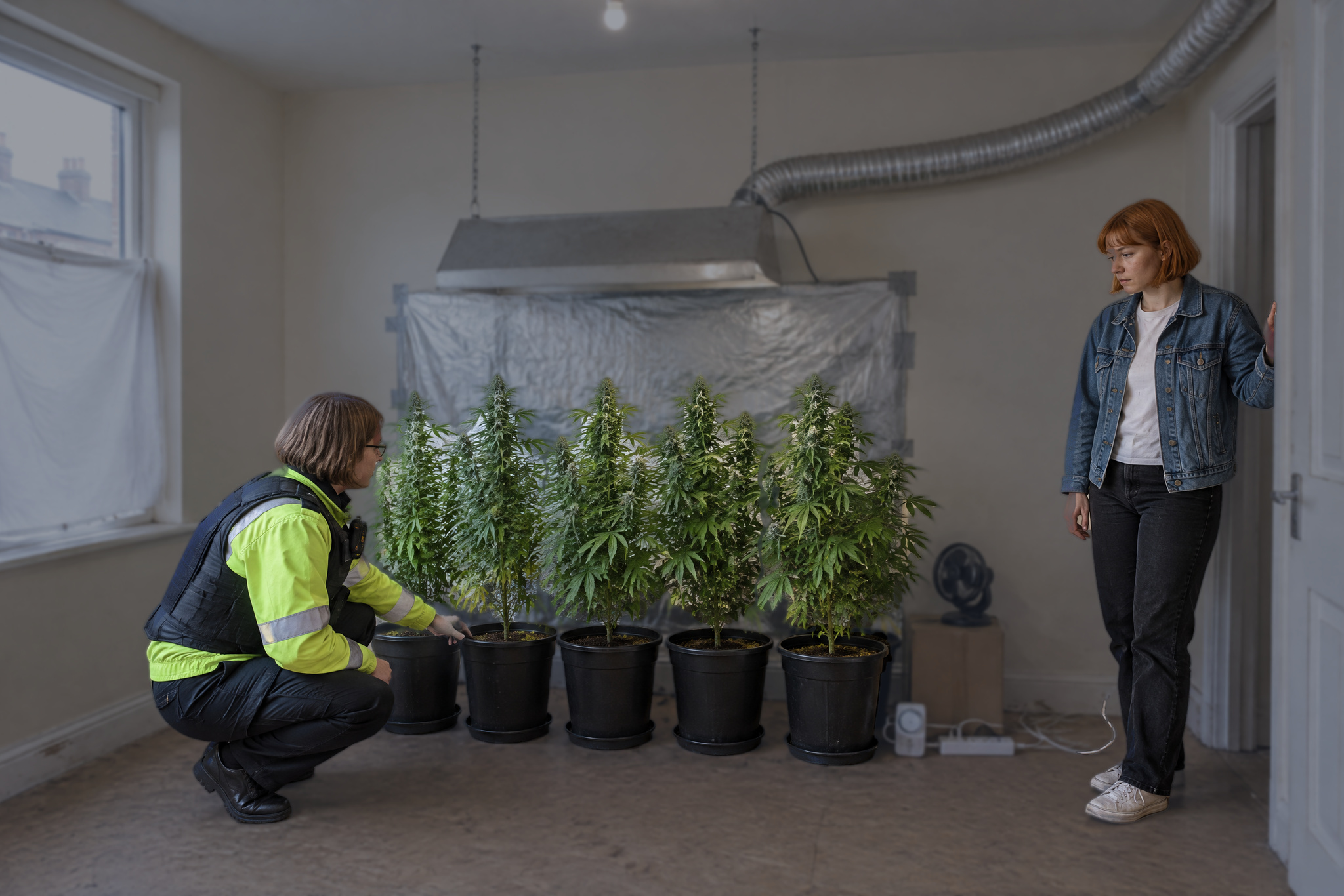






Introduction
Both cannabis cultivation and production can carry a maximum sentence of 14 years’ imprisonment. The outcome depends on several factors, including the number of plants, your involvement and the circumstances of the offence.
This article explains the difference between cultivation and production, how police investigate these offences, what penalties may apply and what to do if you are facing allegations.
What Are Cannabis Cultivation and Production Offences?
The Misuse of Drugs Act 1971 makes it an offence to cultivate cannabis or produce a controlled drug without lawful authority.
Although cultivation and production are closely related, they are separate offences. The distinction can affect how the prosecution approaches a case and whether financial recovery proceedings may follow.
The offence of cannabis cultivation
Cannabis is a Class B controlled drug in England and Wales. Cultivating cannabis involves growing or tending cannabis plants, whether indoors or outdoors.
This may include watering the plants, providing light, and feeding them. A single plant is sufficient to found a cannabis cultivation charge, and the absence of any intent to supply does not prevent prosecution.
The offence of cannabis production
Production is a broader offence and covers manufacturing, cultivating or producing a controlled drug by any other method.
Separating the usable parts of the cannabis plant from the unusable parts can amount to production in its own right.
A person can be guilty of production where they participated in only one part of the process, such as supplying equipment, watering plants or providing funding.
Renting out premises knowing that cannabis cultivation will take place there can also amount to being concerned in production.
Why the distinction between cultivation and production matters
Both offences carry the same maximum sentence, and a person cannot be charged with both cannabis cultivation and production for the same conduct.
The principal practical difference lies in the application of the Proceeds of Crime Act 2002.
Where the prosecution anticipates confiscation proceedings, the choice of charge can carry significant consequences beyond the criminal sentence itself.
Does Growing a Few Plants for Personal Use Make a Difference?
Growing cannabis without lawful authority remains illegal even if you intend to use it yourself. However, the purpose of the cultivation and the number of plants can affect how seriously the offence is treated.
Personal use is not a defence to cannabis cultivation
Cannabis cultivation is unlawful; however, few plants are involved and whatever the stated purpose. There is no personal use exception and no general medical exception allowing home cultivation.
Home Office licences for cannabis cultivation are reserved for pharmaceutical production or scientific research; individuals prescribed cannabis for medical reasons are not permitted to grow their own supply at home.
If you grow cannabis without the necessary authority, saying it was for personal use does not prevent prosecution.
However, it may be relevant when the court considers your role and the seriousness of the offending.
How personal use and plant count interact at sentencing
Plant count and personal use operate on two separate axes within the cannabis cultivation sentencing framework.
The number of plants informs the harm assessment: a higher count indicates greater output and places the case in a more serious harm category.
A claim of personal use, if accepted as credible and reasonable in all the circumstances, is a culpability factor that may support a lesser role finding.
Personal use does not cap the plant count in the harm assessment, and a low plant count does not by itself prove that cultivation was for personal use rather than supply.
What a lesser role looks like in cannabis cultivation cases
The Sentencing Council guideline identifies sole operation for personal use as a lesser role indicator, provided the account is reasonable in all the circumstances.
A lesser role may also arise where a person became involved in cannabis cultivation through naivety, immaturity or exploitation by others.
Courts weigh all the relevant factors together: being found in a lesser role reduces, but does not eliminate, the possibility of a custodial outcome, particularly where the harm category is high.

How Commercial Cannabis Production Allegations Are Assessed
When a cannabis cultivation case reaches sentencing, the court considers two main factors: your role in the operation and the amount of cannabis produced or potentially produced.
These help determine how serious the offence is and the appropriate sentencing range.
Culpability: assessing your role in the cannabis operation
Courts assess culpability by reference to leading, significant and lesser role indicators set out in the Sentencing Council guideline.
Leading role indicators in cannabis cultivation cases include directing or organising cultivation on a commercial scale, substantial links to and influence on others in the supply chain, close links to the source, an expectation of substantial financial gain, use of a business as cover, and abuse of a position of trust or responsibility.
Where the evidence discloses indicators that fall into more than one role category, the court balances them to reach a fair assessment rather than applying any single indicator mechanically.
Lesser role indicators include involvement through coercion, intimidation, grooming or control by others, as well as naivety or immaturity.
These factors may point away from a leading or significant role but need to be supported by evidence; they do not automatically determine the outcome.
Harm: output and potential output of a cannabis grow
Harm in cannabis cultivation cases is assessed by reference to the actual or potential output of the operation.
The Sentencing Council guideline uses indicative plant counts as reference points: seven plants indicates the lowest harm category and twenty plants the next.
Higher categories cover operations capable of producing significant or industrial quantities for commercial use.
Plant count is an indicator rather than a definitive ceiling; other evidence going to the scale and organisation of the cannabis growing operation is also relevant to the harm assessment.
Coercion and exploitation in cannabis cultivation prosecutions
Being recruited or controlled by others can be a significant mitigating factor in cannabis cultivation cases and, in appropriate cases, may support arguments about modern slavery or exploitation.
These are not automatic defences and require evidential support, including consistent and credible accounts alongside any corroborating material.
Where exploitation arguments are available, the evidence needed to support them is best gathered at the earliest opportunity, which makes early legal advice particularly important.
What if You Own or Share the Property Used for Cannabis Cultivation?
Finding cannabis plants at a property does not automatically mean that everyone who owns or lives there is guilty of cultivation or production.
The prosecution must establish the relevant connection between the accused person and the offence.
Responsibility and knowledge in cannabis cultivation cases
Owning or occupying a property where cannabis is cultivated does not automatically establish criminal responsibility.
The prosecution must prove that the person knew about or was involved in the cannabis cultivation or production.
Being concerned in production can include permitting premises to be used for cultivation, but only where there is evidence of knowledge and agreement, expressed or implied.
Landlords, absentee owners and cannabis grows
A landlord may face questions if police discover a cannabis growing operation at a rented property. However, renting out the premises does not automatically make the landlord responsible.
Police may examine whether the landlord knew about the activity, permitted it or was otherwise involved.
Signs such as unusual electricity use, changes to wiring, condensation or restricted access may be relevant to the investigation.
However, these circumstances must be considered alongside other evidence. A landlord is not automatically guilty simply because they failed to notice suspicious activity.
The prosecution must prove the required knowledge and involvement for the offence alleged.
Housemates and shared households
Living in the same property as a cannabis growing operation does not automatically make a person party to the offence.
Proximity and opportunity alone are not sufficient grounds for a cannabis cultivation charge; the prosecution must prove evidence of involvement or knowledge.
The burden of proving every element of the offence beyond reasonable doubt remains on the prosecution throughout.
What Happens During a Cannabis Cultivation Investigation?
Cannabis cultivation investigations may begin following information from the public, surveillance or other police enquiries.
Police may search premises, seize evidence and question people connected with the property.
Search warrants and police attendance at cannabis grows
Police may attend a property following a tip-off, utility analysis, surveillance or other intelligence.
A search warrant may authorise entry and the seizure of cannabis plants, growing equipment and financial records.
Items seized are likely to be used as evidence going to the scale of the cannabis cultivation operation, the person’s role and whether commercial intent can be established.
Arrest and voluntary interview under caution
A person suspected of cannabis cultivation may be arrested at the scene or invited to attend a voluntary interview under caution at a later date.
Both routes are serious: anything said can be used in evidence.
The right to free and independent legal advice before and during a police interview applies in both situations and should be exercised before any questions are answered.
What investigators examine in cannabis cultivation cases
Evidence of scale in cannabis cultivation investigations typically includes plant count, the stage of growth and growing equipment such as lighting rigs, fans, hydroponic systems and timers, as well as yield records where available.
Evidence relevant to role may include communications recovered from phones and devices, financial records and witness accounts.
Evidence of commercial intent may include packaging materials, weighing scales, large quantities of prepared cannabis or the layout and organisation of the growing operation.
Penalties and Sentencing for Cannabis Cultivation and Production
Cannabis cultivation and production can lead to substantial prison sentences, particularly where the operation was large or commercially organised.
However, there is no single sentence that applies to every case.
Courts consider the evidence, the scale of the operation and the person’s role.
Statutory maximum sentence for cannabis cultivation
Both cultivation and production of cannabis carry a maximum sentence of fourteen years’ imprisonment when tried on indictment in the Crown Court.
Less serious cannabis cultivation cases may be dealt with in the Magistrates’ Court, where sentencing powers are more limited.
How the Sentencing Council guideline works for cannabis offences
The Sentencing Council provides guidance to help courts decide appropriate sentences. The court first considers your role, which may be leading, significant or lesser.
It then assesses the harm caused or risked, based on the actual or potential output of the operation.
The guidelines use indicative cannabis plant counts, including seven plants for the lowest harm category and 20 plants for the next category.
The combination of role and harm provides a starting point and sentencing range.
The court then considers any factors that may increase or reduce the sentence.
Aggravating factors in cannabis cultivation sentencing
Previous convictions relevant to the offence will increase the seriousness of a cannabis cultivation case.
These can include relevant previous convictions, sophisticated concealment, operations spread across several premises or the involvement of children or vulnerable people.
Evidence of deliberately obstructing police or targeting vulnerable individuals may also affect sentencing.
The court must consider which factors apply and avoid treating the same circumstances as aggravating the offence more than once.
Mitigating factors in cannabis cultivation sentencing
Mitigating factors may include having no previous convictions, showing genuine remorse or having a limited role in the operation.
Coercion, exploitation or personal circumstances such as mental health difficulties and addiction may also be relevant where supported by evidence.
Financial difficulties may help explain someone’s involvement, although they do not automatically excuse the offence. An early guilty plea can also reduce the sentence.
A solicitor can explain how these factors may apply and what supporting information should be presented to the court.
The range of sentencing outcomes for cannabis cultivation
Not every cannabis cultivation conviction results in immediate imprisonment.
At the lower end, a case involving few plants, limited involvement and strong mitigation may result in a fine or community order.
More serious cases involving large commercial operations can lead to substantial prison sentences.
A small number of plants or a claim of personal use does not guarantee that custody will be avoided.
The final sentence depends on the offence, the evidence and the court’s assessment of your role and the scale of the activity.
Facing Legal Issue?
Speak to one of our Drugs and Conspiracy Defence Specialists for confidential advice on your position and next steps.
Strictly Confidential and No Obligation
What Evidence May Affect Your Cannabis Cultivation Defence?
The evidence in a cannabis cultivation case may determine whether the prosecution can establish your involvement and how seriously the offence is assessed.
Different types of evidence may be important depending on the allegation.
Evidence the prosecution may rely on in cannabis cultivation cases
The prosecution may rely on the number of plants, their stage of growth and evidence of the operation’s potential output.
Growing equipment, including lighting, ventilation and hydroponic systems, may help establish how the plants were maintained.
Financial records may be examined to identify payments for equipment or unexplained income.
Investigators may also rely on messages, phone records, surveillance or witness statements to establish who was involved.
The evidence must be considered as a whole rather than assuming that any single item proves guilt.
Evidence relevant to your cannabis cultivation defence
An absence of knowledge or involvement in the cannabis cultivation is relevant where ownership or occupation of the property is the main connection to the offence.
Evidence of a limited or peripheral role, evidence of coercion, exploitation or grooming, and accounts supported by credible and consistent detail may all be relevant depending on the specific allegation.
Character references and personal circumstances can support mitigation at sentencing.
Statements made under caution in cannabis investigations
Anything you say during a police interview under caution may later be used as evidence.
Your account may support your defence, but statements that are inconsistent with other evidence can also be challenged.
In certain circumstances, a court may conclude from a failure to mention information during interview that you later rely on at trial.
The appropriate response depends on the allegation and the available evidence.
Legal advice before questioning can help you understand your position and the possible consequences of answering questions or remaining silent.
The Role of a Drug Offences Solicitor in Cannabis Cultivation Cases
A solicitor experienced in drug offences can advise you from the beginning of a cannabis cultivation investigation. They can review the allegations, assess the evidence and advise on how to respond during a police interview.
If you are charged, your solicitor can examine whether the prosecution has sufficient evidence to establish your involvement.
They can also consider whether the evidence supports a cultivation or production allegation and whether there are grounds to challenge the prosecution’s case.
Where you had a limited role or were pressured or exploited, a solicitor can identify relevant evidence and advise on any available defence or mitigation.
If the case proceeds to sentencing, they can assess the likely sentencing category and prepare supporting information about your circumstances.
Expert evidence may also be useful where the scale of the operation, estimated cannabis yield or relevant medical issues are disputed.
Early legal advice can help ensure that relevant evidence is preserved and your position is properly considered throughout the proceedings.
5 Key Takeaways
- Growing cannabis without lawful authority is a criminal offence, even if you have only one plant and intend to use it yourself.
- Cultivation and production are separate offences, and a production charge may carry additional financial consequences.
- The number of plants and your role affect sentencing. A small operation does not automatically mean you will avoid imprisonment.
- Owning or living at a property where cannabis is grown does not automatically make you guilty.
- Early legal advice can help you understand the charges and available options, particularly where your involvement, the scale of the operation or allegations of exploitation are disputed.
Frequently Asked Questions
Yes. There is no minimum number of plants required for a cannabis cultivation charge. Even one plant can lead to prosecution, although the number of plants may affect sentencing.
Cultivation involves growing or tending cannabis plants. Production is broader and can include preparing cannabis or participating in other stages of producing it.
No. Growing cannabis without lawful authority remains illegal even if it is intended for personal use. However, a credible personal-use explanation may be relevant when the court considers your role and sentence.
Owning or living at the property does not automatically make you guilty. The prosecution must establish the elements of the alleged offence, including the necessary knowledge or involvement.
Obtain legal advice before answering questions. A solicitor can explain the allegations, review the information available and advise you on how to respond during a police interview.
Evidence that you were threatened, controlled or exploited may be relevant to your defence, your level of involvement or sentencing.
Sentences vary considerably. Smaller cases involving limited responsibility may result in a fine or community order, while large commercial operations can lead to substantial imprisonment.
Call us on 0333 009 6275. We are available to take your call 24 hours a day, 7 days a week.
You can also email us on enquiries@ashmanssolicitors.com or complete our Online Enquiry Form and we’ll be in touch soon.
Get in touch
We’ll respond within 15 minutes during office hours
Search our legal articles
Free expert guidance on criminal law, your rights, and what to expect at every stage.
Searching Legal Help Hub articles
Related insights and updates

Consent and Intoxication: Can You Be Convicted If Both People Were Drunk?

New Year’s Eve Drug Arrests: What Police Look For and Your Rights

Can a First-Time Drug Possession Charge Be Avoided? Cautions, Resolutions and Diversion

Can a Drug Offence Affect My Visa or Immigration Status?

Arrested for Drug Offences in the UK: What You Should Do

Conspiracy to Supply Drugs (Class A & Class B) – UK Law and Sentencing

Caught With Cocaine in the UK: Laws, Penalties and Legal Consequences

Possession of Controlled Drugs in the UK: What Happens if You Are Caught?

Common Assault vs ABH vs GBH: What Is the Difference and How Serious Is Each Charge?

New Year Digital Clear-Out: Why Deleting Images or Messages During an Investigation is a Crime

Coercive Control Allegations: What the Offence is, How It is Proven & How to Defend It

Christmas Holidays, Group Chats and Knife Images: Why Police Contact Parents in January

Cannabis Cultivation Charges: From Growing a Few Plants to Commercial Production

New Year Amnesties & Foreign Prosecutions: Using Quiet Months to Resolve an Extradition Case Abroad

Criminal Law Changes in 2026: Key Developments in England and Wales

Christmas Bonus Season & Insider Dealing: Why Year-End Trading Draws FCA Scrutiny

Can You Travel Abroad With a Criminal Conviction From England and Wales?

Can the Court Order My Dog to Be Destroyed and How Do I Prevent It?

Can My Employer Find Out About a Sexual Offence Arrest?