Legal Help Hub
Falsely Accused of Domestic Abuse: Your Rights and How to Prove an Allegation Is False






Introduction
If you have been falsely accused of domestic abuse in England and Wales, you may face arrest, restrictions on contacting your family or having to leave your home before a court has considered the allegations.
Being accused does not mean you are guilty. The prosecution must prove its case beyond reasonable doubt, and you do not have to prove your innocence.
However, evidence that challenges an allegation can make a significant difference to the outcome. Knowing what to preserve, how to respond to the police and when to seek legal advice can help protect your position.
This article explains what happens after a domestic abuse allegation, your rights during an investigation, the evidence that may help challenge a false accusation and the possible outcomes.
It focuses on criminal proceedings in England and Wales, with family court matters covered where relevant.
What Happens When a Domestic Abuse Allegation Is Made
How the police typically respond
Police treat domestic abuse reports as a priority. Arrest is common even where the available evidence is limited, and officers will often act first and investigate afterwards.
The process begins moving quickly and largely independently of what the person accused says at the door.
Once an allegation has been recorded, the responding officers have little practical discretion to pause.
Their duty is to protect the person making the report, and that duty shapes every decision taken at the scene.
What “domestic abuse” covers under current law
The Domestic Abuse Act 2021 created the first statutory definition of domestic abuse in England and Wales. It extends beyond physical violence to include psychological, emotional, economic and controlling behaviour.
A false domestic abuse allegation therefore does not need to involve any physical contact.
The evidence relevant to it must be assessed across a wide range of claimed conduct, including communications, financial matters and patterns of behaviour.
The breadth of the definition also means that an investigation may examine a longer period of time than the accused person might expect.
Immediate consequences before any court decision
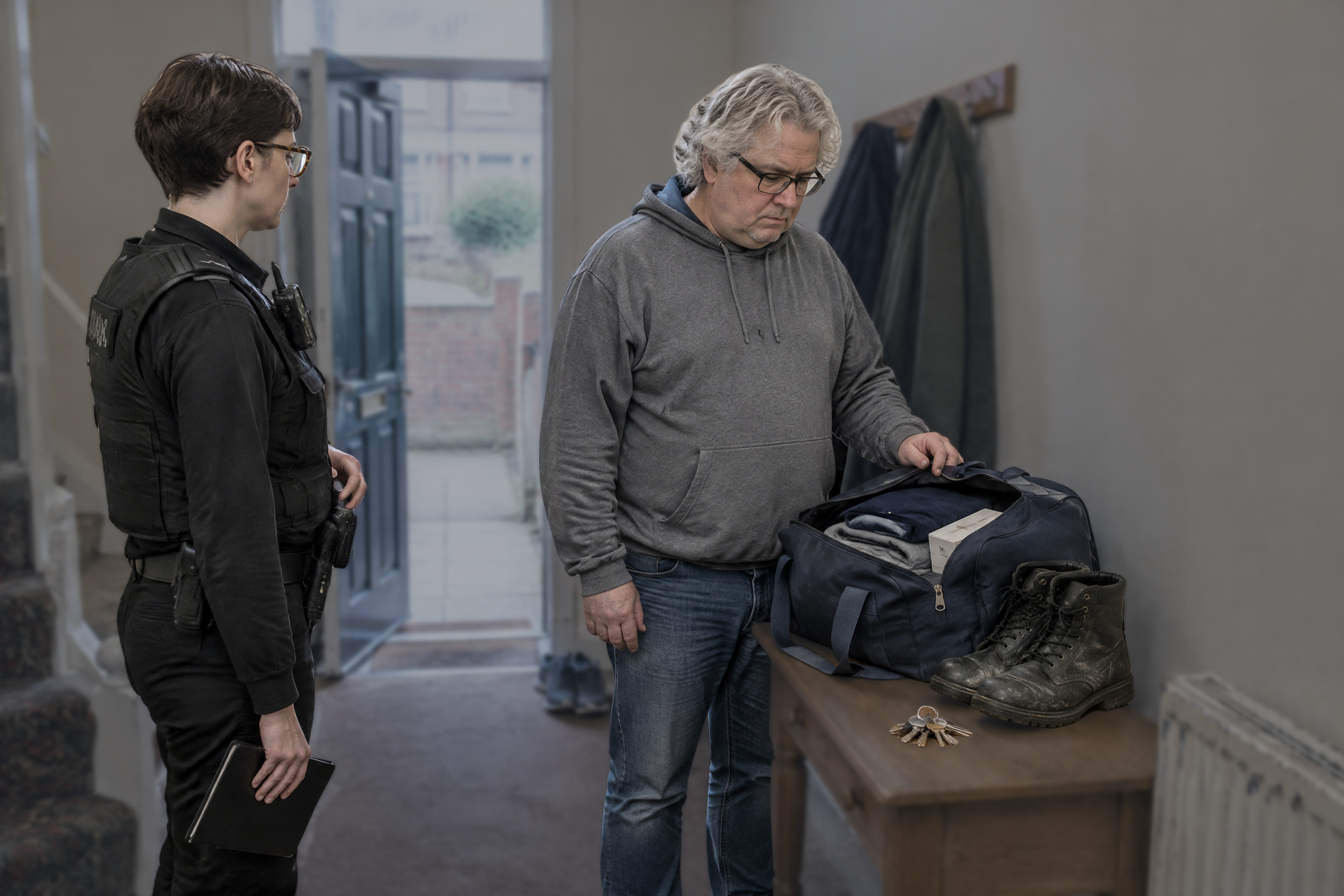
Bail conditions may be imposed that prohibit contact with the complainant and exclude the accused person from their own home.
Employment, housing and contact with children can all be affected before any charge is brought.
These consequences are restrictions, not punishments, but their practical effect can be severe.
Bail conditions are imposed on the basis that they are necessary and remain in force until varied or the matter is resolved.
Anyone falsely accused of domestic abuse who finds bail conditions disproportionate or unworkable should raise this with their solicitor, who can apply to have them reviewed.
What to Do if You Believe a Domestic Abuse Allegation Is False
Instruct a solicitor before you say anything
If you believe you have been falsely accused of domestic abuse, seek legal advice before taking part in a police interview.
You may feel that explaining everything immediately will resolve the allegation. However, answering questions without understanding what is being alleged or what evidence the police hold can create difficulties later.
Even an accurate account may contain details that need clarification. A solicitor can explain the interview process, discuss the allegations and advise you on how to respond.
Obtaining legal advice does not suggest guilt. It allows you to make informed decisions from the beginning of the investigation.
Preserve evidence now, not later
Preserve complete message threads, emails and call logs without alteration. Screenshots can be useful but they lose the metadata attached to the original record.
Original records in their native format are more useful to a defence solicitor and to any expert who may later need to examine them.
Note dates, times and locations relevant to the period covered by the false domestic abuse allegation. Identify potential witnesses promptly, as memories fade and accounts can change.
Deleting messages that appear unhelpful is a serious trap. Doing so can amount to a criminal offence and will undermine the defence.
The correct approach is to retain everything and let a solicitor assess what is relevant.
Do not contact the complainant
Contact restrictions are likely to be in place as a bail condition. Breaching a bail condition is itself a criminal offence, separate from the original allegation.
Any approach to the complainant, however well-intentioned, is likely to be treated as evidence of pressure or harassment.
Attempting to resolve the matter directly is one of the most common mistakes made by those falsely accused of domestic abuse and one of the most damaging.
If there are practical matters to address, such as access to a shared home or arrangements for children, a solicitor can advise on the correct route.
Do not publish accusations or discuss the case publicly
Posting about the allegation on social media or making public statements naming the complainant may constitute harassment under the Protection from Harassment Act 1997 or contempt of court.
It will not help the defence and is likely to create additional legal difficulties.
Online activity is routinely reviewed by investigators and prosecutors. Posts, comments and messages made during the investigation period may be disclosed as evidence.
The safest approach is to say nothing publicly about the case while it is ongoing.

Your Rights During a Police Investigation
The right to legal advice
The right to independent legal advice under PACE applies at any point during custody, not only at the beginning.
A person falsely accused of domestic abuse may request a solicitor at any time, including during an interview that has already started. If that request is made, the interview should pause until legal advice has been obtained.
This right is not means-tested. It applies regardless of the accused person’s financial circumstances and regardless of the seriousness of the allegation.
The police caution and what it means
Before questioning you as a suspect, the police will normally give you a formal caution explaining your right to silence and the possible consequences of not mentioning something you later rely on in court.
You do not have to answer every question. However, silence may have legal consequences in certain circumstances, particularly if important facts are raised for the first time during a later defence.
This does not mean you should automatically answer all questions or remain silent throughout.
Your solicitor can consider the allegations, the information disclosed by police and any relevant evidence before advising whether to answer questions or provide a prepared statement.
Voluntary interview versus interview under arrest
A person can be invited to attend a voluntary interview under caution without being arrested.
The same rights apply as in a formal post-arrest interview, including the right to free legal advice and the same caution wording.
The absence of an arrest does not reduce the significance of what is said.
Do not attend a voluntary interview without a solicitor.
The fact that you have not been arrested may feel reassuring, but anything said in that interview can be used as evidence in the same way as a post-arrest interview.
Do You Have to Prove Your Innocence When Falsely Accused of Domestic Abuse?
In criminal proceedings in England and Wales, the burden of proof rests on the prosecution throughout. The prosecution must prove the case beyond reasonable doubt.
The accused does not have to prove innocence, and the presumption of innocence applies at every stage of the process.
The accused may choose to put forward an account or present evidence.
That is a tactical choice made with legal advice, not a legal obligation. Remaining silent, or choosing not to call witnesses, does not shift the burden to the defence.
Before charging, the Crown Prosecution Service (CPS) must apply the Full Code Test.
The first stage requires the CPS to be satisfied that there is a realistic prospect of conviction. This is an objective test: a jury or bench of magistrates, properly directed in accordance with the law, would be more likely than not to convict the defendant on the charge alleged.
If the evidence does not meet that threshold, the case must not proceed to charge, regardless of how serious the allegation is.
If the case does reach court, the jury or magistrates must be sure of guilt before convicting.
That standard is higher than the charging threshold. A false domestic abuse allegation alone does not come close to satisfying it.
Evidence That May Help Challenge a False Domestic Abuse Allegation
Digital and electronic records
Messages, emails and call records can help establish what happened before, during or after an alleged incident.
Complete conversations may provide context that is missing from individual screenshots. Timestamps can also help confirm when particular exchanges took place.
Location records, travel bookings and bank transactions may support your account of where you were or what happened on a particular day.
Preserve original records where possible. Your solicitor can advise on what is relevant and how the material should be provided to investigators.
CCTV and third-party footage
CCTV can provide an independent record of events and may support or contradict an account of an alleged incident.
Footage from shops, nearby properties, workplaces or vehicles could be relevant, depending on where the events are said to have occurred.
Many CCTV systems automatically overwrite recordings after a limited period. It is therefore important to identify potentially useful footage quickly.
Your solicitor can advise on requesting its preservation and how it may be obtained through the police investigation or other appropriate procedures.
Witness evidence
People who witnessed an incident or have direct knowledge of relevant events may be able to provide evidence.
Their accounts might help establish a timeline, confirm where you were or explain circumstances that have been disputed.
Identify potential witnesses early, but avoid discussing what they should say or encouraging them to support a particular version of events.
Your solicitor can advise on obtaining witness accounts without creating concerns about interference or coordinated evidence.
Medical and other professional records
Where an allegation involves physical injury, medical records may be relevant to the timing, nature or cause of the reported injuries.
Other professional records may also assist where they document events or circumstances connected to the allegation.
However, the absence of a medical record does not establish that abuse did not occur. Not all forms of domestic abuse involve injury, and some injuries may not have been reported or treated.
Medical information is sensitive and should be obtained through lawful procedures. Your solicitor can advise on the appropriate steps.
What “insufficient evidence” means in practice
If there is not enough evidence to meet the relevant charging test, the police or CPS may decide not to proceed.
However, insufficient evidence is not the same as proof that an allegation was deliberately fabricated.
A decision not to charge may simply mean that the available evidence does not provide a realistic prospect of conviction. Similarly, an acquittal means the prosecution has not proved the case to the required standard.
These distinctions matter when someone wants to establish that a domestic abuse allegation was false. Challenging the evidence against you is different from proving that the person who reported the allegation knowingly lied.
Contact Restrictions, Children and Practical Arrangements
Bail conditions and non-molestation orders
If you are released on pre-charge bail following a domestic abuse allegation, the police may impose conditions restricting contact with the complainant or preventing you from visiting certain places.
These conditions must meet the relevant legal requirements and can be challenged or varied through the appropriate process.
A complainant may also apply to the family court for a non-molestation order. This is a separate protective order that may prohibit certain behaviour or contact.
Breaching a non-molestation order without reasonable excuse is a criminal offence. Breaching pre-charge bail conditions, although not itself a criminal offence, can lead to arrest and further restrictions.
If both apply, you must comply with each. A solicitor can explain how the restrictions interact and advise on any application to change them.
Children and contact arrangements
Being accused of domestic abuse does not automatically mean you lose the right to see your children.
However, bail conditions or protective orders may affect how contact can take place, particularly if the children live with the complainant.
The family court makes decisions about child arrangements based on the child’s welfare. It applies different rules and standards of proof from those used in criminal proceedings.
A criminal investigation or acquittal does not automatically determine the outcome of a family court case.
If contact has become difficult or stopped altogether, a family law solicitor can advise on the arrangements that may be available while the criminal investigation continues.
Do not attempt to make arrangements that conflict with existing bail conditions or court orders.
Housing and practical access
Being excluded from your home can create immediate problems, particularly if you need clothing, medication, work equipment or important documents.
Your solicitor may be able to help arrange access to essential belongings without breaching any restrictions.
Owning the property or being named on the tenancy does not automatically allow you to return while a valid bail condition or court order prevents access.
Where housing arrangements are disputed, legal advice may be needed to address both the criminal investigation and any related family court proceedings.
Facing Legal Issue?
Speak to one of our Domestic Offences Defence Specialists for confidential advice on your position and next steps.
Strictly Confidential and No Obligation
Offences and Potential Penalties in Domestic Abuse Cases
Domestic abuse covers different forms of conduct rather than one single criminal offence. The offence charged depends on the allegations and available evidence.
Penalties vary considerably, so it is important to understand what the police are investigating and what consequences could follow if the prosecution succeeds.
Common assault and assault occasioning actual bodily harm
Common assault may involve unlawful physical contact or causing someone to fear immediate unlawful violence.
It can carry a maximum sentence of six months’ imprisonment. Where the offence is committed in a domestic context, the court may treat that relationship as an aggravating factor.
Assault occasioning actual bodily harm (ABH) applies where an assault causes injury that is more than minor or temporary.
ABH can be heard in either the magistrates’ court or Crown Court and carries a maximum sentence of five years’ imprisonment on conviction on indictment.
Grievous bodily harm
Grievous bodily harm (GBH) involves serious injury, although the precise offence depends on the circumstances and the defendant’s state of mind.
An offence involving unlawful wounding or inflicting GBH without the specific intent required for the more serious charge can carry a maximum sentence of five years’ imprisonment.
Where the prosecution proves the required intent to cause serious injury, the maximum sentence can be life imprisonment.
The seriousness of the injury, how it occurred and the evidence of intent are important factors when determining the appropriate charge and sentence.
Assault by strangulation or suffocation
Non-fatal strangulation or suffocation is a specific criminal offence introduced through the Domestic Abuse Act 2021.
It covers intentional strangulation and certain acts that affect another person’s ability to breathe. Serious injury does not have to be visible for the offence to apply.
The offence can be tried in either the magistrates’ court or Crown Court and carries a maximum sentence of five years’ imprisonment.
The court considers the circumstances of the incident, the degree of harm and relevant sentencing factors when determining the penalty.
Controlling or coercive behaviour
Controlling or coercive behaviour is a criminal offence where repeated or continuous conduct meets the legal requirements relating to a personally connected person and causes the necessary serious effect.
Physical violence is not required. Allegations may concern monitoring communications, controlling access to money, isolation from other people or other patterns of behaviour.
Because the offence concerns repeated conduct, investigations may cover months or years and involve extensive messages, financial records and witness accounts.
The maximum sentence is five years’ imprisonment. The prosecution must establish the elements of the offence rather than simply show that a relationship was difficult or unhappy.
Harassment and stalking
Harassment and stalking allegations may also arise in domestic situations, particularly where repeated unwanted contact or behaviour is reported.
Less serious harassment and stalking offences can carry maximum sentences of six months’ imprisonment.
More serious offences involving fear of violence or serious alarm or distress can carry sentences of up to ten years’ imprisonment.
Breaching a restraining order is a separate offence and may result in imprisonment.
The evidence usually concerns a course of conduct rather than an isolated incident, so messages, contact records and the wider circumstances may be relevant.
Sentencing and the domestic context
When an offence is committed against someone who is or was personally connected to the offender, that relationship can be a statutory aggravating factor.
Courts also consider the seriousness of the conduct, harm caused, culpability, any history of offending and other relevant circumstances.
These sentencing consequences apply only if a person is convicted. They should not be confused with bail conditions or temporary restrictions imposed during an investigation.
If you are falsely accused of domestic abuse, the potential sentence depends on the particular offence alleged, not simply the fact that the accusation concerns a domestic relationship.
Court Outcomes: Acquittal, No Further Action and What They Mean
Domestic abuse investigations can end in several ways without a conviction. Each outcome has a different legal meaning.
A no further action (NFA) decision means the police or CPS have decided not to proceed at that stage. This may be because the evidence is insufficient, prosecution is not considered appropriate or the case cannot otherwise be taken forward.
NFA is not an acquittal and does not amount to a formal finding that the allegation was false.
An acquittal occurs when a court finds the defendant not guilty. It means the prosecution has failed to prove the offence to the required criminal standard.
However, an acquittal does not automatically establish that the complainant deliberately made a false allegation.
A separate investigation may be required where there is evidence that someone knowingly fabricated a report. Depending on the circumstances, deliberately making a false allegation could lead to offences such as wasting police time or perverting the course of justice.
These proceedings do not arise simply because someone has been acquitted or their case has been dropped.
The outcome of a criminal case may also leave separate family court matters unresolved. Decisions about children and contact arrangements are made under different rules, and the family court may consider evidence independently of the criminal proceedings.
How a Solicitor Can Help if You Are Falsely Accused of Domestic Abuse
If you believe you have been falsely accused of domestic abuse, a solicitor can help you understand the allegation, your rights and the evidence that may be relevant to your defence.
Before a police interview, they can explain the questioning process and advise you on how to respond. During the investigation, they can help preserve evidence, identify relevant witnesses and communicate with the police or CPS on your behalf.
Where bail conditions prevent contact with your family or access to your home, a solicitor can advise on whether those restrictions can be varied.
If criminal charges follow, they can explain the court process, assess the prosecution’s evidence and prepare your defence.
Seeking advice early can help prevent avoidable difficulties, particularly where evidence may be lost or decisions made during the investigation could affect later proceedings.
Our domestic offences team advises individuals facing domestic abuse allegations, including disputed or potentially false accusations, police interviews, bail restrictions and criminal proceedings.
If you have been accused of domestic abuse and are concerned about what happens next, contact Ashmans Solicitors for advice about your circumstances.
Send an Online Enquiry
5 Key Takeaways
- Being falsely accused of domestic abuse does not establish guilt, but an investigation may still lead to arrest, bail conditions or restrictions on contact.
- Obtain legal advice before a police interview so you understand the allegation, your rights and how to respond.
- The prosecution must prove the offence beyond reasonable doubt, although you can provide evidence that challenges the allegation.
- Preserve complete messages, digital records, CCTV and relevant witness details without deleting or altering evidence.
- A no-further-action decision or acquittal does not automatically prove an allegation was false, and related family court matters may continue separately.
Frequently Asked Questions
Police do not need conclusive proof to arrest you, but they must have reasonable grounds to suspect an offence and believe arrest is necessary. An allegation may provide grounds for suspicion, depending on the circumstances, but arrest is not automatic.
The police and CPS decide whether a case continues, not the complainant. A prosecution may still proceed if there is sufficient evidence, even where the complainant withdraws support. Their wishes are considered but do not determine the outcome.
No. However, bail conditions or protective orders may temporarily restrict contact. The family court considers the child’s welfare when deciding arrangements, and a solicitor can advise on the options available during the investigation.
Recording a conversation without consent is not automatically unlawful in every situation, but the circumstances and use of the recording matter. Do not record anyone in breach of bail conditions or court orders, and obtain legal advice before attempting to gather evidence this way.
Bail conditions apply during an investigation or criminal proceedings and may restrict contact or movement. A restraining order is imposed by a criminal court to protect someone from harassment or other prohibited conduct and can be made following conviction or acquittal. Breaching a restraining order without reasonable excuse is a criminal offence.
NFA means the police or CPS are not proceeding with the case at that stage. It does not prove the allegation was false, and certain police information may still be disclosed in an enhanced DBS check where the legal requirements are met. A solicitor can advise if you are concerned about your record or employment.
Call us on 0333 009 6275. We are available to take your call 24 hours a day, 7 days a week.
You can also email us on enquiries@ashmanssolicitors.com or complete our Online Enquiry Form and we’ll be in touch soon.
 Imran Ali
Get in touch
We’ll respond within 15 minutes during office hours
Search our legal articles
Free expert guidance on criminal law, your rights, and what to expect at every stage.
Searching Legal Help Hub articles
Related insights and updates

New Year Separation: What to Do If Your Ex-Partner Makes an Allegation After You Leave

Coercive Control Allegations: What the Offence is, How It is Proven & How to Defend It

Can Domestic Abuse Charges Be Dropped If the Complainant Withdraws?

Breach of a Non-Molestation Order: What Are the Consequences?

Stalking Protection Orders in the UK: Legal Guide and Defence Advice

Victimless Prosecution in Domestic Violence Cases: UK Law Explained

FCA Investigation: What Are My Rights and What Happens Next?

Falsely Accused of Domestic Abuse: Your Rights and How to Prove an Allegation Is False

Failing to Identify the Driver (Section 172): The Offence That Catches Company Car Drivers

Does a Youth Conviction Stay on My Child’s Record?

UWO Response: What It Requires and What Happens Next

What to Do if You Are Named in a Buy-to-Let Mortgage Fraud Investigation

Wedding Deposit Fraud Allegations: What Happens When Couples Report a Supplier

Arrested for Printing Fake Documents a Customer Supplied: What Print Shop Owners Need to Know

Dangerous Dog Charges: What Happens If Your Dog Bites Someone?

Cyberstalking and Online Harassment: When Does It Become a Criminal Offence?

Criminal Records and Employment: What Can Employers Legally Ask?

Dawn Raid on Your Business Premises: A Step-by-Step Response Plan

New Year Job Hunting With a Criminal Record: What Shows on a DBS Check in 2027